
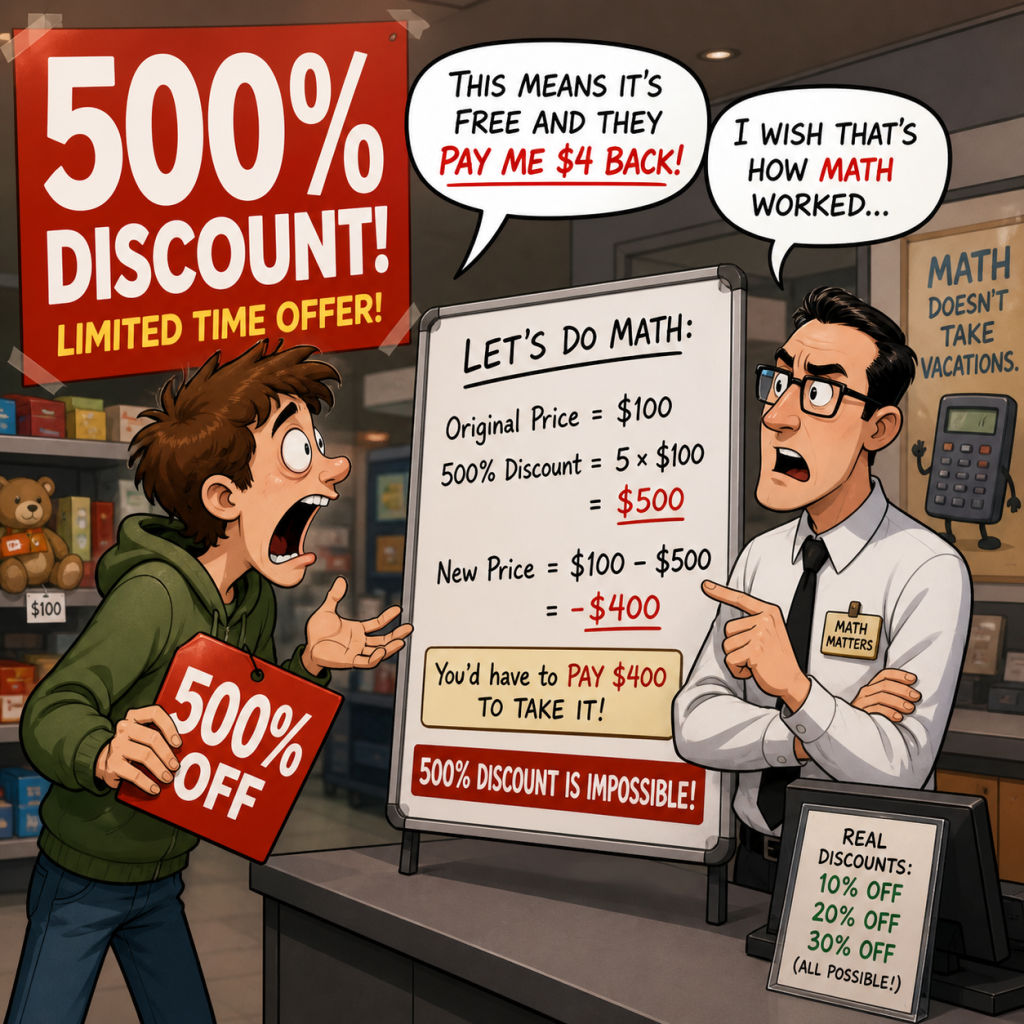
When politicians or advertisers claim something is offered at a “500% discount,” it’s mathematically impossible (NOT POSSIBLE!). A discount reduces the price, from the original price. A discount more than 100% doesn’t make sense.
Understanding Percentages (review):
A percentage is a part of 100. A 100% discount means you get the full value of an item for free. If something costs $100, a 100% discount brings the price to $0. A 20% discount on that same $100 item brings the price to $80.
So, what Does 500% Mean?
A 500% discount means the discount is five times the original price. If an item costs $100, a 500% discount would mean you’re paid $400 to take the item. This situation is impossible—prices can’t go below zero, and no one is going to pay you to buy something.
Politicians or advertisers often use exaggerated claims to make what they’re saying “sound” more appealing. They often make the same bogus mathematical claims over and over to try to legitimize what they’re saying (or, sadly, they actually believe what they’re saying is true).
But a “500% discount” is not only misleading but simply wrong. Such a stated discount grabs attention, but the claim doesn’t hold up with even 6th grade math. If the discount were actually 500%, we would get a discount percentage larger than 1 — see Example 2 below.
A discount percentage larger than 100% (1) is economically meaningless as a pure discount, because it would require the seller to pay the buyer.
Let’s look at a couple examples to better understand.
Example 1 below is a normal situation we encounter.
Example 2 below would never happen, but is the exact situation politicians and others say with a straight face over and over is what “would” happen.
Example 1: A Simple Discount Calculation (Normal Situation)
Let’s say a car that normally costs $30,000 is at a 15% discount. What do we actually end up paying in this case?
Step 1: Convert the percentage: 15% = 0.15. (15/100 = 0.15)
Step 2: Calculate the discount: 0.15 × $30,000 = $4,500. ($4,500 is the discounted amount “off” the price)
Step 3: Calculate the final price (full price minus discount): $30,000 – $4,500 = $25,500.
Example 2: What Would a 500% Discount Look Like? (Fictional and Absurd — You make money!)
Let’s imagine, just for fun, that a car is offered at a 500% discount. Hurray! This “discount” matches the absurd political language you actually hear on TV over and over.
Below we use the same three steps as in the above example.
Step 1: Convert 500% to a number we can use to multiply. As above divide the percent by 100. So, 500% = 500/100 = 5. (Wow, this discount is greater than 1!)
Step 2: Calculate the discount: 5 × $30,000 = $150,000. Notice that the discount is now five times the sales price!
Step 3: Calculate the final price: $30,000 – $150,000 = – $120,000.
So, $120,000 means the dealer would pay you $120,000 to take the car, which is clearly impossible and would never happen.
The first 100% is the total cost of the car, or $30,000. The next 400% is four times the sales price or 4 * 30,000 = $120,000. So, in this case, $120,000 is what the dealer would PAY YOU!
Sidebar: When Do Students Learn About Percentages?
Students usually start learning about percentages in grades 4 or 5 (ages 9-11). By middle school (grades 6-8), they should be able to calculate percentages and apply them to real-world situations like discounts.
By high school, students understand that a 100% discount means an item is free, and any discount above 100% is impossible, as it would imply a negative price.
Unfortunately, many students are not getting the math skills they need. Studies show over half of U.S. adults (57%) read at or below an 8th-grade level, and critical thinking in education is often overlooked and undervalued. This educational erosion (some say collapse) makes it harder to for citizens to do basic math, basic reasoning, or critical thinking.
https://nces.ed.gov/surveys/piaac
The percent doesn’t act the same increasing a cost as decreasing it
You can increase a $100 item to $600 and that is a 500% discount, but going the other way is not a 500% discount! Regardless of how many people tell you it “matters how you consider it and you could have a 500% discount.”, it’s impossible
Going the other way from $600 to $100 is the difference between the two values divided by the original number: ($600-$100)/$600 = $500/600 = 83% discount.
Conclusion:
A “500% discount” (or any discount > 100%) is mathematically impossible. Any “discount” greater than 100% would be money paid to you! Anyone who claims a discount > 100% is possible either does not understand middle school math (likely) or is lying to you.
It could be argued that such spouted mathematical incompetence is either intentional and meant to distract from other issues or to say rather than having an actual plan for what’s being discussed.
Don’t be fooled!
—
Please read our disclaimer on our home page…